The awards night of the “100 Yazar 100 Yeni Eser” (100 Writers, 100 New Works) project, launched to leave a literary legacy for the second century of our Republic, took place on Friday 6 February 2026.
Former Speaker of the Turkish Grand National Assembly İsmail Kahraman: “Literature keeps the spirit alive; this is not a closing but an opening for new writers.”
Prof. Dr. Nevzat Tarhan: “Writing is a matter of discipline, not inspiration. Young people who do not chase popular culture, who can write their own feelings and express themselves, are the leaders not of today but of tomorrow. Clearing the way for these leaders is our responsibility.”
Istanbul Deputy Governor Mustafa Asım Alkan: “The project builds not only today but the future as well.”
The awards night of the “100 Yazar 100 Yeni Eser” project, launched to leave a literary legacy for the second century of our Republic, took place on Friday 6 February 2026.
Supported by the Ministry of the Interior's Directorate General for Relations with Civil Society, under the patronage of the Istanbul Governorship and with the academic guidance of Üsküdar University, the project was coordinated by the Çanakkale and Thrace Education and Culture Confederation and carried out with the implementation support of the İlim ve Fazilet Foundation Educational Institutions.
The awards ceremony and closing programme were held to a packed house at Üsküdar Municipality's Bağlarbaşı Congress and Culture Centre. Many figures from academia, literature, civil society and public life attended the evening.
Former Speaker İsmail Kahraman: “Writing is no easy task”
In his speech, former Speaker of the Turkish Grand National Assembly İsmail Kahraman stressed that literature is the essential element that makes us human: “We must not be mechanical, robotic people, but people with spirit and energy. That is exactly what literature provides.” Noting that literature carries a value beyond the social and technical sciences, Kahraman said: “Matter can be obtained one way or another, but the spirit is indispensable. We must speak to the spirit. We must not be materialists – and literature makes that possible.”
Describing the project as extremely valuable, Kahraman said: “This is not a closing meeting, it is an opening. We have aspiring writers who are only at the beginning of the road. Literature keeps the spirit alive; this is not a closing but an opening for new writers. Writing is no easy task; with time and hard work, many strong writers will emerge from among them.”
“As we discarded our words, we grew poorer”
Drawing attention to the steady decline in the richness of Turkish vocabulary, Kahraman said that this impoverishment of the language directly affects literature. “As we discarded our words, we grew poorer. While hundreds of thousands of words are used in developed countries, we have squeezed ourselves into a much narrower space. Metre, rhyme and harmony in poetry have been pushed into the background. These are not good developments,” he said, stressing that greater effort is needed in poetry and literature.
Observing that a positivist approach to education had sidelined spiritual values, Kahraman noted that a recovery has begun in this area in recent years: “Today we have 209 universities and millions of students. There has been great progress and we are moving in a better direction.”
“Our President has declared this year the ‘Year of the Family’”
In his speech, İsmail Kahraman also referred to the “Year of the Family” declared by President Recep Tayyip Erdoğan, emphasising that protecting the family is a social necessity. “Our President has declared this year the ‘Year of the Family’. The process is planned to continue for ten years, because we have serious problems within the family,” he said.
Pointing to falling marriage rates and the shrinking young population, Kahraman said: “The proportion of children born outside marriage is above 70 per cent in Switzerland and Ireland, and 68 per cent in France. Here it is 2.8 per cent. This picture shows how vital it is to protect the family structure. We must resist a society that we might call illegitimate and preserve our own structure.”
Istanbul Deputy Governor Mustafa Asım Alkan: “The project builds not only today but the future as well”
Istanbul Deputy Governor Mustafa Asım Alkan stressed that the project was an extremely valuable gain for young people. Noting that it draws them away from the risky and unproductive corners of the digital world, Alkan said: “One of the most important aspects of this work is that it lifts our young people out of the unproductive and risky atmosphere of the digital world and gives them the chance to create on a bright path such as writing a book.”
Remarking that the project opens up the possibility of bringing young people into the literary world at national and international level, Alkan concluded: “Seen in this light, the project builds not only today but the future as well.”
Prof. Dr. Nevzat Tarhan: “Bad texts are the raw material of good texts.”
Speaking at the closing programme of the “Edebiyatımızın Yeni Yüzyılına 100 Yeni Eser” (100 New Works for the New Century of Our Literature) project, Üsküdar University Founding Rector Prof. Dr. Nevzat Tarhan described it as an important undertaking that will leave its mark on young people's lives: “Today we are closing a very precious project that touches the souls of our young people and could become a milestone on their journey through life.”
“Writing is a matter of discipline, not inspiration”
Saying that “writing is a matter of discipline, not inspiration”, Prof. Dr. Tarhan thanked all the academics, mentor teachers and stakeholders who contributed to the project: “Projects like this are like signposts in young people's lives. They show the way, give courage and leave a mark.” Pointing out that the writing process also involves making mistakes, he said: “Bad texts are the raw material of good texts. There are two kinds of people who never make mistakes: those who have not been born and those who have died. That is why we should not be afraid of making mistakes.”
Turning to the contributions made to the project, Prof. Dr. Tarhan emphasised that cooperation between academia and civil society has a powerful effect on young people: “Here, both our teachers and our young people worked with great enthusiasm and determination. This synergy is one of the most important reasons for the project's success.”
“Writing takes courage”
Likening writing to “deep-sea diving”, Prof. Dr. Tarhan said: “Writing takes courage. It requires asking questions, going deep, intellectual objection and intellectual rebellion. Only then can one reach the truth.”
Highlighting the influence of popular culture, Prof. Dr. Tarhan said: “Young people who do not chase popular culture, who can write their own feelings and express themselves, are the leaders not of today but of tomorrow. Clearing the way for these leaders is our responsibility.”
Stressing that young people should be in search of meaning and values, Prof. Dr. Tarhan recalled the saying attributed to Ali, “Raise your children for the age in which they will live”, adding: “We too must prepare our young people for the future they will live in. Young people without ideals, who chase only pleasure and self-interest, fall into the traps of global culture. But young people with meaning and purpose in their lives can say ‘no’ to what is wrong.”
“Read, but do not imitate”
Also touching on the importance of the reading habit, Prof. Dr. Tarhan urged young people to “read a lot”: “Read the classics, know the past, but don't stop there. Follow the modern and contemporary works of your time too. Read, but do not imitate.” Saying that the young people who took part had taken an important step towards becoming “the writers of the future”, he closed his speech with the words: “When I see the energy in this hall, I believe with all my heart that there will be Nobel laureates among them.”
Project Adviser İshak Koçoğlu: “Writing takes courage”
Project Adviser and İTO (Istanbul Chamber of Commerce) Assembly Member İshak Koçoğlu said that the young writers' work was not merely a project output but a concrete sign of faith in the future. “Being here today means bearing witness to the marks left on the future by young people who think with their pens and take responsibility with their words,” he said.
Emphasising that the young people had done more than produce works during the process, Koçoğlu said: “Writing takes courage; but greater courage still is to declare and share what you have written. Our young people showed that courage.” Underlining the support of families, he added: “Behind these achievements lies the quiet but powerful support of our families. You believed in your children and stood by them.”
Turning to the contributions of mentor teachers and advisers, Koçoğlu said: “Our teachers taught our young people not only literature but also how to think, to critique and to take responsibility. This effort will bear fruit in the country's cultural life for many years to come.”
Koçoğlu ended his speech with the words: “Literature is the strongest bridge built between the past and the future. Today we have young people laying new stones on that bridge. May your path be clear and your pen strong.”
İlim ve Fazilet Foundation President Mahmut Ekşi: “A great success with 105 works”
Speaking at the ceremony, İlim ve Fazilet Foundation President Mahmut Ekşi stressed that the project was not only a literary undertaking but also the product of an effort to raise a generation centred on national and spiritual values. Remembering with mercy the citizens who lost their lives in the 6 February earthquakes centred on Kahramanmaraş, Ekşi underlined the importance of young people growing up with a sense of history, love of country and responsibility.
Noting that there had been doubts at the start of the project but that a great success had been achieved with the 105 works that emerged, Ekşi said he was especially proud that primary school pupils had written books.
“I thank everyone who contributed. In my schools, a first-year primary pupil wrote a 30-page book. All of us went to university, one or two of us, yet if someone told us to ‘write’, we couldn't. But those teachers guided them, and today we have 105 bright children – some have written 50 pages, some 100, some 70, some 80. If just 10 of them become writers one day, is that a small thing?” said Ekşi, concluding his speech by expressing his belief that the writers nurtured by this project would make an important contribution to Türkiye's cultural future.
Thanks from the young writers
At the closing programme of the “100 Yazar 100 Eser” project, three students took the stage on behalf of the young writers to share their thoughts and feelings. The young writers emphasised that the project had been not just a writing experience for them but an important journey in thinking, questioning, gaining self-confidence and finding the courage to create. Giving the first speech on behalf of the young writers, Büşra Aksoy highlighted the role of literature in understanding oneself and society, and said that in the Republic's second century young people bear the responsibility of preserving the richness of the language and speaking to the future.
Young writer Alperen Engin Öztürk said the “100 Yazar 100 Yeni Eser” project had given them a sense of responsibility and self-confidence, adding that the process was not an end for the young writers but a new beginning from which they would go on writing and creating.
Ayça Nermin Tarhan: “We will keep writing – sometimes for hope, sometimes for justice, sometimes simply to remain human…”
Ayça Nermin Tarhan said that receiving an award was not just a success for them but a reward for existing through words and never giving up on their dreams.
Saying that the project had given young writers the feeling that their stories were valuable and their voices worth hearing, Tarhan said: “I would like to thank my grandfather, Professor Doctor Nevzat Tarhan, Founding Rector of Üsküdar University, and my mother and father for believing in my words, always encouraging me, and walking ahead of me rather than standing in my way. On behalf of all the young writers here, I want to say that we will keep writing. Sometimes for hope, sometimes for justice, sometimes simply to remain human. I offer my gratitude to all the institutions, our dear teachers and everyone who made this meaningful journey possible. How glad we are that we write, how glad we are that we have our words.”
Müjgan Tarhan: “Writing is a child's courage to express themselves”
Speaking as the parents' representative at the awards ceremony, Müjgan Tarhan said she had attended the evening with a mother's feelings: “As our children wrote, we witnessed their excitement and we believed in them. Because writing is a child's courage to express themselves. I wholeheartedly thank all the institutions, our educators and our teacher Nevzat who contributed to this meaningful project. And dear young people: keep writing. Because your words will shed light on the world of tomorrow. As a mother, I thank you all.”
Writing became a process of courage and healing for the students
Speaking at the awards ceremony of the “Edebiyatımızın Yeni Yüzyılına 100 Yeni Eser” project, mentor and educator Sevda Gürbüz stressed that the project went beyond producing literary works and created an important space opening onto the inner worlds of children and young people. Noting that the project enabled young people to express their emotions through writing, Gürbüz said that for the students writing was at times a relief and at times a process of courage and healing.
The project concluded with 105 young writers and 105 works
Giving an information presentation, Assist. Prof. Dr. Nebiye Yaşar said the project was not just a cultural undertaking but a powerful signature by young people on the future, and that the project – shaped by the young writers' enthusiasm and courage to create – was the product of 14 months of intensive work. Yaşar noted that the work, which set out with the goal of “100 Writers, 100 Works”, was completed with 105 young writers and 105 works, and that behind each work lay the faith, effort and dreams of young people.
Yaşar said workshops had been run with 16 mentor teachers and a strong, sustainable interaction had been established with the young writers, adding that the seminars held as part of the project also aimed to raise young people's awareness of digital rights.
A gift from granddaughter to grandfather
At the event held as part of the “100 Yazar 100 Eser” project, a special family-themed segment was staged, highlighting the “Year of the Family” declared by the President. Speaking during the programme, Dr. Nebiye Yaşar said that family-themed stories had been written and projects brought to life during the process, and announced that a symbolic “family photo” would be taken with the young writers.
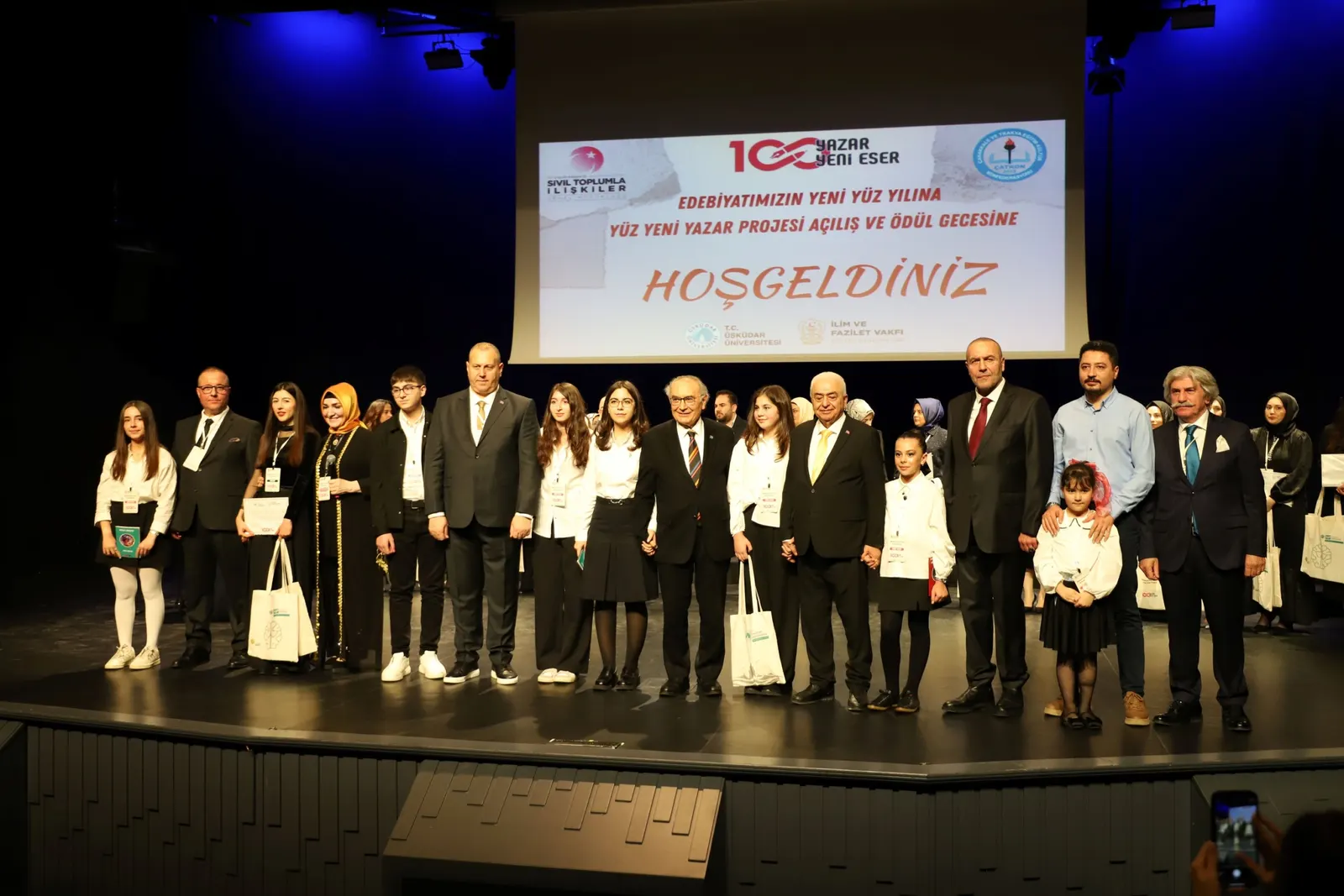
Ayça Nermin Tarhan, Almira Kavak, Duru Ekşi, Doruk Ekşi, Mira Ekşi, Azra Arslan and the project's youngest writer, Eylül Kırkıl, were invited to the stage. The young writers then invited family members and advisers to the podium, creating some deeply moving moments.
Taking the podium at the invitation of his granddaughter Ayça Nermin Tarhan, Prof. Dr. Nevzat Tarhan stressed that young people choosing truth over popularity in their creative work is a hopeful sign for Türkiye's future.
Family members invited by the other young writers also gave short speeches of thanks. During the programme, the young writers also presented gifts to their advisers.
Awards for 100 young writers
Later in the programme, the 100 young writers who took part in the project received their awards, and the mentor teachers were presented with certificates of appreciation. The awards and certificates were presented by former Speaker of the Turkish Grand National Assembly İsmail Kahraman; Istanbul Deputy Governor Mustafa Asım Alkan; Prof. Dr. Nevzat Tarhan, Founding Rector of Üsküdar University and Chair of its Executive Board; Furkan Tarhan, Chair of the Üsküdar University Board of Trustees; Üsküdar District Governor Adem Yazıcı; Üsküdar District Director of National Education Semih Durmuş; İTO Assembly Member İshak Koçoğlu; İlim ve Fazilet Foundation President Mahmut Ekşi; Müjgan Tarhan; and TARHAN – İDER Foundation Board Member Fırat Tarhan.
The evening, also attended by Üsküdar University Rector Prof. Dr. Nazife Güngör, came to a close with a group photograph.